How to start forex trading as a beginner in 2026 with a simple plan
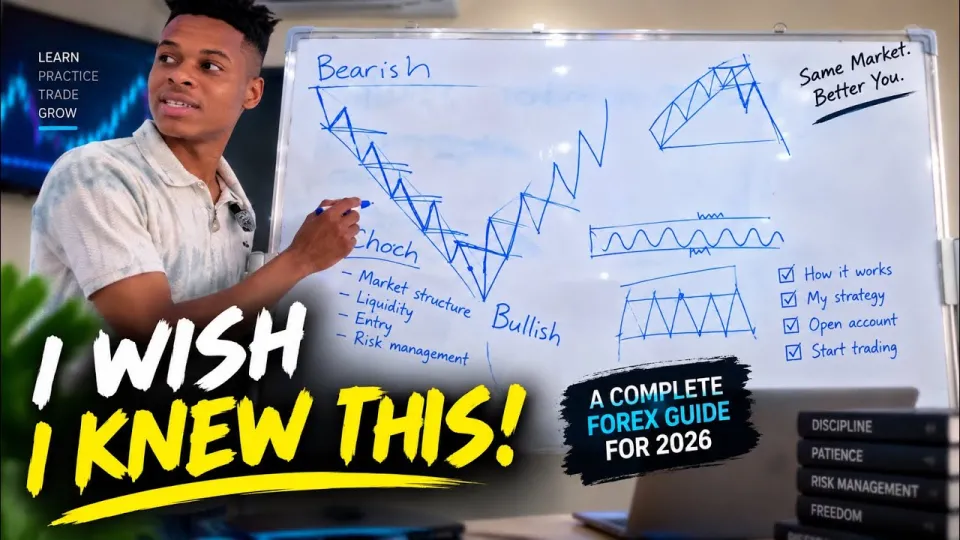
Video: How To Start Forex Trading For Beginners in 2026 (Full Guide + My Strategy)
Need articles like this for your video? They help promote it on YouTube and Google — order them in the Telegram bot @sat_sit_bot. It writes articles around your video, embeds the video and publishes them on popular niche websites (no ads). Free trial — 50 articles.
· based on the channel Carl Fx
Forex trading for beginners starts with three concrete steps: learn how currency pairs are quoted and priced, open and fund a broker account only after testing a demo, and trade one written strategy with a fixed risk limit per position. Everything else — indicators, signals, prop firms, copy trading — is secondary to those three foundations. This guide follows the structure of Carl Fx's beginner walkthrough and adds the practical detail you need before risking money; you can register an account through TFC Global Markets, the broker the channel's author owns and promotes.
What forex trading actually is and how the market is structured
Forex is the market where national currencies are exchanged in pairs, and the price you see is simply how much of the quote currency one unit of the base currency costs. EUR/USD at 1.0850 means one euro buys 1.0850 US dollars. There is no central exchange: trading happens over the counter through a network of banks, funds and brokers, which is why your broker's spread and execution quality matter as much as your analysis.
The market runs 24 hours a day from Monday morning in Sydney to Friday evening in New York, split into sessions — Sydney, Tokyo, London and New York. Liquidity peaks when London and New York overlap, and that overlap is where most beginner strategies find their cleanest moves. The most traded pair is EUR/USD, followed by USD/JPY and GBP/USD; exotic pairs offer bigger moves but wider spreads and thinner liquidity.
Retail traders rarely take delivery of currency. Positions are usually closed before settlement, and profit or loss comes from the price difference multiplied by position size. That leverage effect is what makes small accounts interesting and dangerous at the same time.
How to open a forex trading account step by step
Opening an account takes minutes online, but the sequence matters more than the speed. Treat registration as the last step of preparation, not the first step of trading.
- Choose a regulated broker and check which regulator supervises it, what leverage it offers to clients in your country, and how it handles withdrawals.
- Complete registration and identity verification (KYC) with a passport or ID and proof of address; verification usually clears within a day.
- Open a demo account first and trade it for at least four to eight weeks, logging every trade.
- Fund a live account with an amount you can lose without changing your life — commonly a few hundred dollars for a first account.
- Install the platform (MetaTrader 4, MetaTrader 5 or a proprietary app), set up one chart layout and stop adding tools.
If you go with the broker linked in the video, the sign-up page is https://www.tfcglobalmarkets.com/sign-up?ref=CARLFX — note that the channel author discloses ownership of that company, so weigh the recommendation accordingly and compare at least one independent regulated alternative.
Reading bullish and bearish markets through market structure
Market structure is the skeleton of price action: it tells you whether buyers or sellers currently control the chart. In a bullish market, price prints higher highs and higher lows; in a bearish market, lower highs and lower lows. When that pattern of swings breaks, the trend is at least pausing, and that break is often the first warning before a reversal.
A workable beginner routine on any timeframe:
- Mark the last three or four swing highs and swing lows on a daily and a four-hour chart.
- Label the trend: rising structure, falling structure, or range.
- Wait for price to return to a level where the previous move started — a former swing low in an uptrend, a former swing high in a downtrend.
- Only look for entries in the direction of the higher-timeframe structure.
This is the core of price action trading: no indicator predicts direction, but structure shows where the odds sit. Most beginner losses come from buying into falling structure or selling into rising structure because a candle looked oversold or overbought.
A simple beginner strategy you can practise this month
A simple strategy beats a complicated one because it can be tested and repeated. One version that fits the structure approach above:
- Pick one pair (EUR/USD is the usual starting point) and two timeframes: four-hour for direction, fifteen-minute for entries.
- On the four-hour chart, confirm the trend from swing highs and lows.
- On the fifteen-minute chart, wait for a pullback into a zone where the last impulse began.
- Enter after a clear rejection candle closes in the trend direction, with the stop-loss beyond the swing that created the zone.
- Set the target at the previous high (in an uptrend) or previous low (in a downtrend), giving at least a 1:2 risk-to-reward ratio.
- Take a screenshot of every setup, win or lose, and review the log weekly.
Expect a low win rate at first; the point of the exercise is consistency, not a hot streak. A strategy with a 1:2 reward-to-risk ratio can be profitable with fewer than half of trades winning, but only if the risk per trade stays fixed.
Risk management rules that keep a small account alive
Risk management is the difference between a learning curve and a blown account. Decide the maximum you will lose on a single trade before you enter, and size the position from that number rather than from the lot size you feel like trading.
A common framework: risk 1% of account equity per trade, never more than 2%. On a $500 account that is $5 per trade, which on a 20-pip stop means a micro lot of roughly 0.025 — small, and that is the point. Add a weekly loss limit, for example 5% of equity, and stop trading when it is hit. Avoid holding multiple positions in correlated pairs such as EUR/USD and GBP/USD, because they behave like one oversized trade.
Leverage is a tool for freeing margin, not for increasing risk. A 1:500 account does not require you to use 1:500 exposure, and most beginners who blow up do so by confusing the two.
Common beginner mistakes and the questions new traders ask most
Most beginner mistakes are behavioural, not analytical. The recurring ones: jumping to a live account before a demo proves anything, changing strategy after three losses, revenge trading after a stop-out, risking more than planned because a setup "looks perfect", and following signal groups instead of learning to read a chart. Another frequent trap is expecting fast income — trading is a skill business with a long ramp, not a shortcut.
Viewers of the guide raise practical doubts worth answering directly. Many ask whether a real account can be opened from a country where the broker's registration flow is awkward — the answer is to check the broker's accepted jurisdictions and documents before depositing, and to use a regulated local alternative if verification fails. Others ask for chart examples because text explanations feel abstract; the fix is to open a demo chart, mark the last swings yourself and compare with the explanation. A third group starts on demo and wonders when to go live: the usual benchmark is two to three months of logged trades with a stable process, not a profit target.
Useful links
- Account registration with TFC Global Markets (broker owned by the channel author): https://www.tfcglobalmarkets.com/sign-up?ref=CARLFX
- Free Telegram community run by the channel: https://t.me/carlsmcforex
Bottom line
Forex trading rewards a boring, repeatable process: understand how pairs are priced, verify a broker, prove a single strategy on demo, and protect capital with a fixed risk per trade. The guide from Carl Fx covers exactly that path — market structure first, entries second, risk always — and is a sensible starting point for anyone building a foundation rather than chasing a signal. If you want to follow the author's own workflow, start with the TFC Global Markets registration and the free Telegram community, but keep the demo phase and the 1–2% risk rule regardless of where you open the account. Trading carries significant risk and profits are never guaranteed.
Key takeaways
- Forex is an over-the-counter market where currencies are quoted in pairs such as EUR/USD, and retail traders usually access it through a broker's platform rather than a central exchange.
- A demo account should come before real money: it lets you test order types, spreads and a written strategy without risking capital.
- Market structure — higher highs and higher lows versus lower highs and lower lows — is the base for reading bullish and bearish trends before any entry.
- Risk per trade is the number that keeps a small account alive; many experienced traders cap it at 1–2% of equity and define the stop-loss before entering.
- Carl Fx, the author of the guide reviewed here, discloses that he owns TFC Global Markets, the broker he links to for account opening.
Source: How To Start Forex Trading For Beginners in 2026 (Full Guide + My Strategy) · Markdown version
Questions & answers
How much money do I need to start forex trading?
You can open a live account with a few hundred dollars, and many brokers set minimum deposits between $10 and $200. The more useful question is position size: with $500 and a 1% risk rule you risk $5 per trade, which keeps losses survivable while you learn. Starting on a demo account costs nothing and should come first.
How long should I practise on a demo account before trading real money?
A reasonable benchmark is two to three months of consistent, logged trading, or at least 50 recorded setups. The signal to go live is a stable process — fixed risk, a written strategy, no rule-breaking — rather than a profit figure on the demo. Go live with a small amount and treat the first months as paid tuition.
Is forex trading gambling?
Without a method it becomes gambling, because outcomes depend on random bets sized by emotion. With defined entries, stop-losses and a fixed percentage risk per trade, it is a probabilistic skill activity where a minority of winning trades can cover the losers. The difference is process and position sizing, not the market itself.
Do I need indicators or can I trade with price action alone?
Price action alone is enough, and beginners often do better with a clean chart: swing highs and lows show the trend, and zones show where the previous move started. Indicators such as moving averages can help confirm a trend but lag price. Pick one approach, test it on demo and stop adding tools when results wobble.